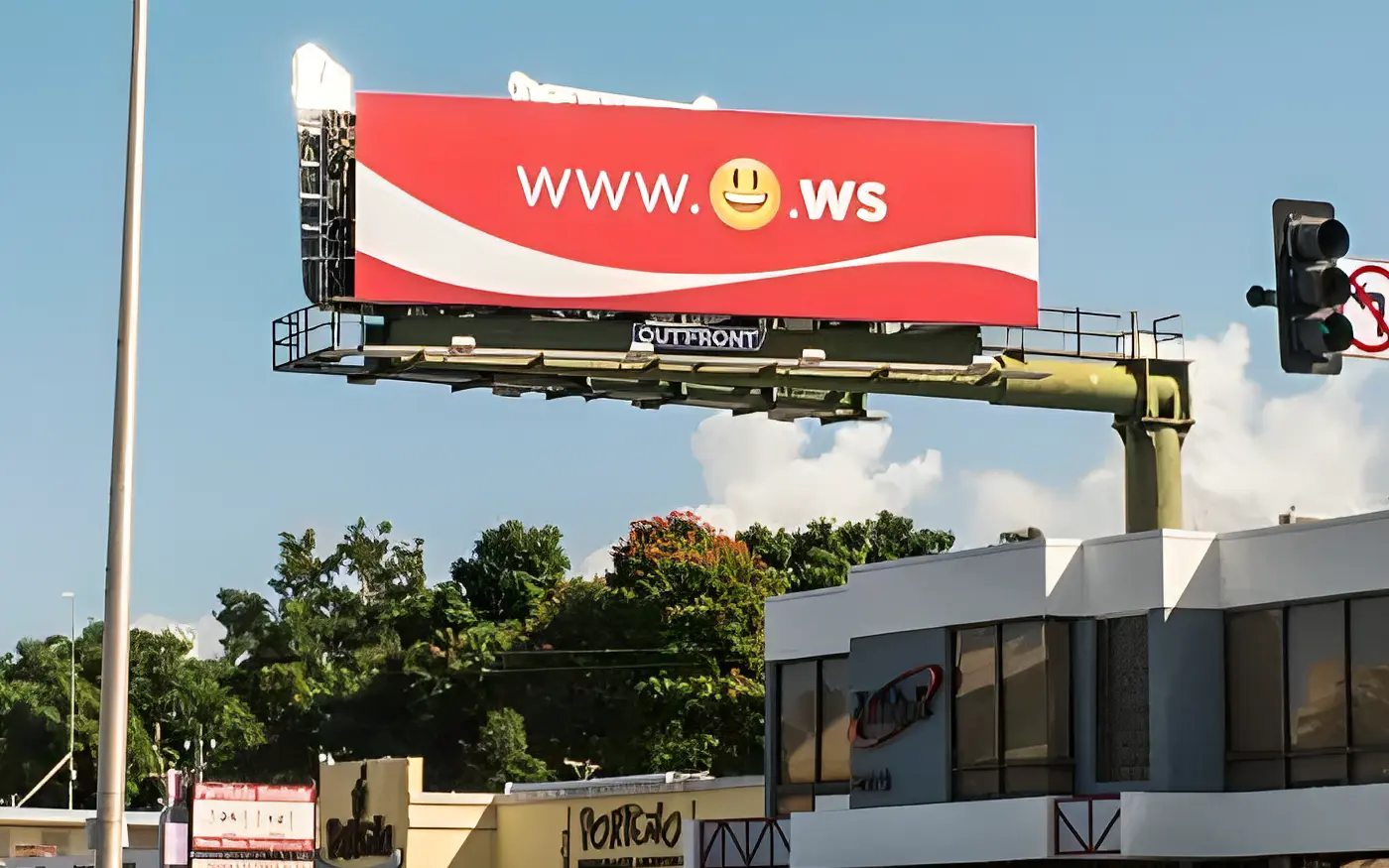
The most useful precedent for emoji domains is not the one people usually cite. It is a soft drinks campaign in Puerto Rico that ran for a few weeks in February 2015, and it did something no registry record can: it put a symbol on a billboard and asked the public to use it.
What actually ran
Coca-Cola Puerto Rico registered a web address for every emoji that conveys happiness. Adweek reported that typing any of them into a mobile browser led to the brand’s site. These were not decorative marks in a layout — they were registered domains that resolved. The work is credited to DDB Puerto Rico, and the campaign was called EmotiCoke.
The design was as spare as it gets: the Coca-Cola red, the white wave, and an address made of a symbol. No product shot, no slogan, no explanation.
The detail worth copying
Look closely at the board and you find three letters doing an enormous amount of work: www. in front of the symbol.
This is the answer to the objection every marketer raises about the format — how does a passer-by know that a symbol is a web address rather than decoration? Coca-Cola did not solve it with a caption or a logo lockup. It solved it with a prefix everyone has been reading since 1995. If you print a symbol on outdoor media, print www. in front of it. It costs nothing and removes all ambiguity.
It went further than most people remember
The billboards were only half of it. Through a mobile site, Coca-Cola let people in Puerto Rico build their own emoji address and enter a draw, with winners keeping a permanent one. La Réclame reported the winners were announced on 24 February 2015.
That is a meaningfully bigger bet than a billboard. The brand was not just showing consumers an unfamiliar format; it was asking them to make one themselves, and wagering that enough people would understand it to make a competition work. In 2015, before most of the objections raised about emoji domains today had even been formulated.
Why .ws, and why that reasoning matters
The obvious question is why an agency working for Coca-Cola would choose Samoa’s country code. The answer came in two steps, and both are on the record.
First, a constraint. DDB told Adweek that
Emojis are not accepted on domains such as .com, .net, and .org
, so the agency researched which
registries did accept them. That is not a creative decision, it is arithmetic: emoji domains exist on
a handful of extensions and nowhere else.
Then, a choice among the survivors. La Réclame reported that .ws was selected because the letters could be read as “We Smile”, close to the brand’s own open happiness signature.
A technical shortlist, then a symbolic pick from it. That is the identical reasoning behind putting this register on .to: the extension is one of the few that accepts symbols, and it happens to read as an instruction in English. When someone dismisses that as a stretch, it is worth knowing that one of the world’s large agencies made the same two-step decision for Coca-Cola.
Coca-Cola versus the basketball record
Both precedents matter, and they prove different things.
| What it demonstrates | |
|---|---|
| 🏀.to | A symbol can be held as a brand asset: registered since 2015, renewed, locked against transfer on corporate registrar infrastructure, resolving to Nike Basketball. Ownership, not usage. |
| EmotiCoke | A symbol can carry an advertising campaign: outdoor media, a mass-market brand, a global agency, and consumers invited to participate. Usage, not ownership. |
For anyone considering a symbol as a campaign address on printed media, the second is the closer parallel. The basketball record shows that serious companies protect these. EmotiCoke shows that a serious company put one in front of the public and it worked.